UX CASE STUDY · AI AUTOMATION · June to October 2026
A 2am inquiry, booked in about 10 seconds, and a person only when it needs one.
Harbourview is an intake pipeline for a small family law firm. A web inquiry gets parsed by Claude, checked against the firm's conflict list, and booked into a free consult slot, or routed to a person when it shouldn't be automated. It is a demo for a fictional BC firm, dry-run tested and kept offline between demos.
- Role
- Solo Designer & Builder
- Timeline
- June to October 2026
- Stack
- Make · Claude Haiku · Google Sheets · Gmail · Google Calendar · Slack
- Constraint
- Demo for a fictional firm
See It Run
Forty-four seconds, no sound. One scenario, three ways an inquiry can go.
The Problem vs. The Solution
Small firms get inquiries at all hours. Someone has to read each one, check the names against the conflict list, find a consult slot, and write back. That is a staffer's whole morning, and by then the lead may have called another firm. Speed matters, but a missed conflict is what can actually hurt the firm.
The morning inbox
Every inquiry waits for a person, including the ones a person adds nothing to.
Book the obvious, stop at conflicts, hand off the rest
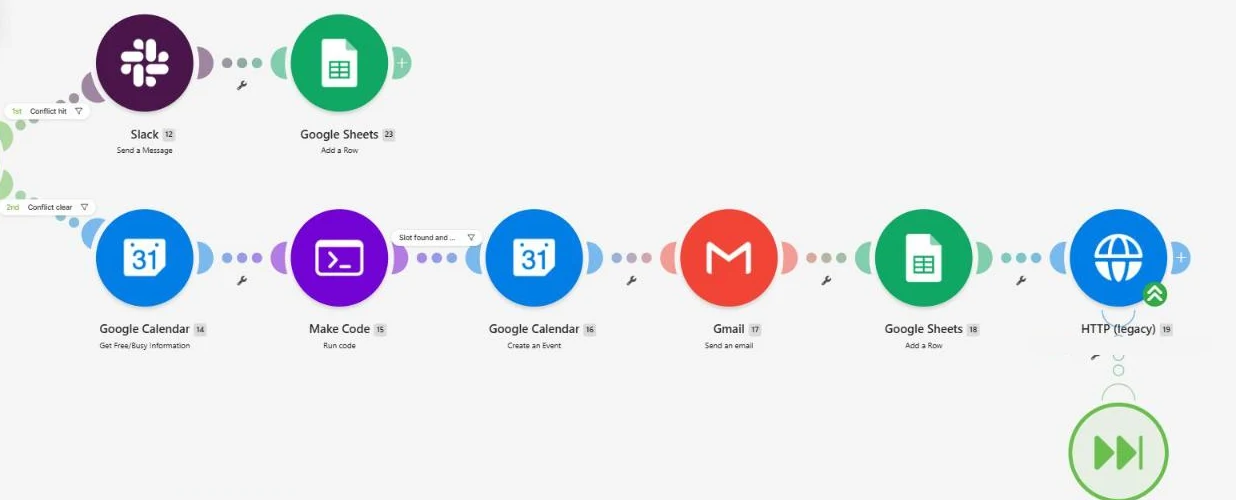
One Make scenario runs every inquiry through the same five stages. Anything that isn't a polite decline gets a row in the ledger.
The Same Inquiry, Both Ways
A web inquiry handled by hand, then by the pipeline.
- 01Inquiry waits in the inbox
- 02Staffer reads and sorts it
- 03Checks names against the conflict list
- 04Looks for a free consult slot
- 05Writes and sends a reply
- 06Logs it in the tracker
- 01Form posts to the webhook
- 02Claude parses it to JSON
- 03Router and conflict gate decide
- 04Booked, declined, or sent to a person
- Inquiry waits in the inbox
- Staffer reads and sorts it
- Checks names against the conflict list
- Looks for a free consult slot
- Writes and sends a reply
- Logs it in the tracker
- Form posts to the webhook
- Claude parses it to JSON
- Router and conflict gate decide
- Booked, declined, or sent to a person
The five stages
Every inquiry runs the same path: parse, route, check conflicts, book, hand off. The decline and needs-a-person branches leave at the router and the conflict gate.
Key Design Decisions
Six calls shaped how far the pipeline is trusted to act on its own.
DEC-01 A parser, not an advisor The model's job is reading, not judgment. Keeping it to a fixed schema makes every downstream branch testable. What happened
Claude Haiku runs at temperature 0 and returns structured intake JSON: contact, matter category, urgency, conflict names, red flags and a confidence score. It never answers the legal question, and the confirmation email carries a no-advice line.
DEC-02 Below 0.7 confidence, a person decides An unclear inquiry costs a few minutes of someone's time. A wrong automatic booking costs the client's trust. What happened
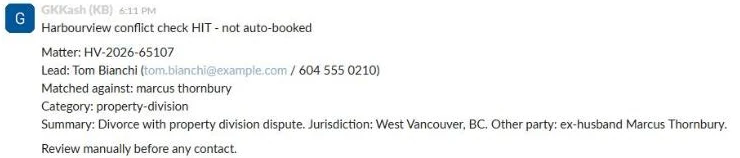
Low confidence, an urgent matter, or a parse that sets handoff_required sends the lead to Slack with the reason and the score, and the ledger row says NEEDS_HUMAN.
DEC-03 The conflict list lives in a data store The firm can update its list without touching the flow, and the rule that matters most can't be bypassed by a branch. What happened
A code module matches every name on the other side against the firm's list in a Make data store. A hit posts "conflict check HIT, not auto-booked, review manually before any contact" and stops there.
DEC-04 Sequential processing after a double booking A green run means the modules didn't error. It doesn't mean the outcome was right. What happened
Make runs instant scenarios in parallel by default. Three test leads sent at once all read the same free slot and all booked it. Every run showed green. Turning on sequential processing fixed it.
DEC-05 A failed handoff never undoes a booking The booking is the promise to the client. The prep email is a nice extra, and it shouldn't be able to break the promise. What happened
After booking, the scenario posts to the Navigator Handoff scenario. That step has an Ignore error handler, so if the handoff fails, the client's appointment still stands.
DEC-06 Nothing waits silently Sending a lead to a person only works if a person sees it. The sweep stays quiet on a clean day, so a message from it means something. What happened
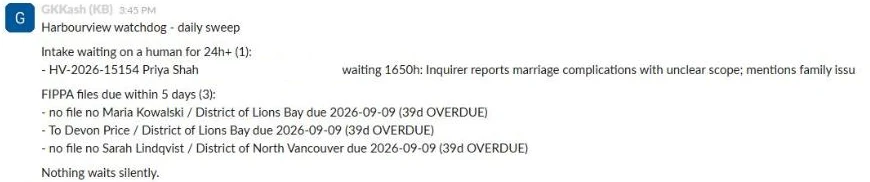
A watchdog runs daily at 16:45. It reads the leads and FIPPA ledgers, flags any lead that has waited on a person for 24 hours or more and any FOI file due within five days, and posts to Slack only when the count is above zero.
Inside the Pipeline
Make canvases and test-run outputs, all with fictional data. Every image opens full size.
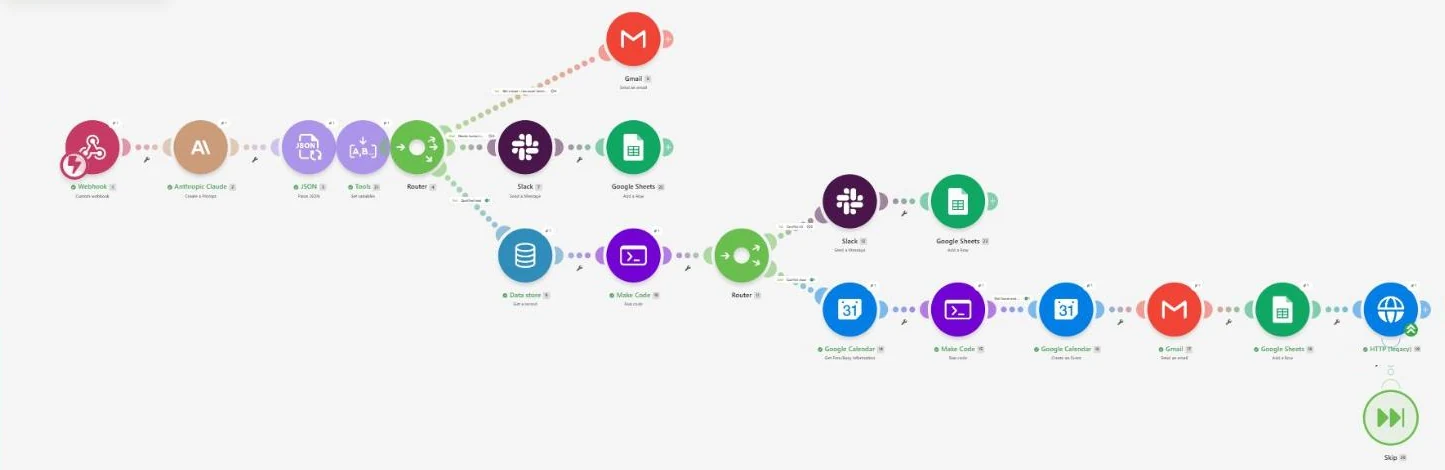
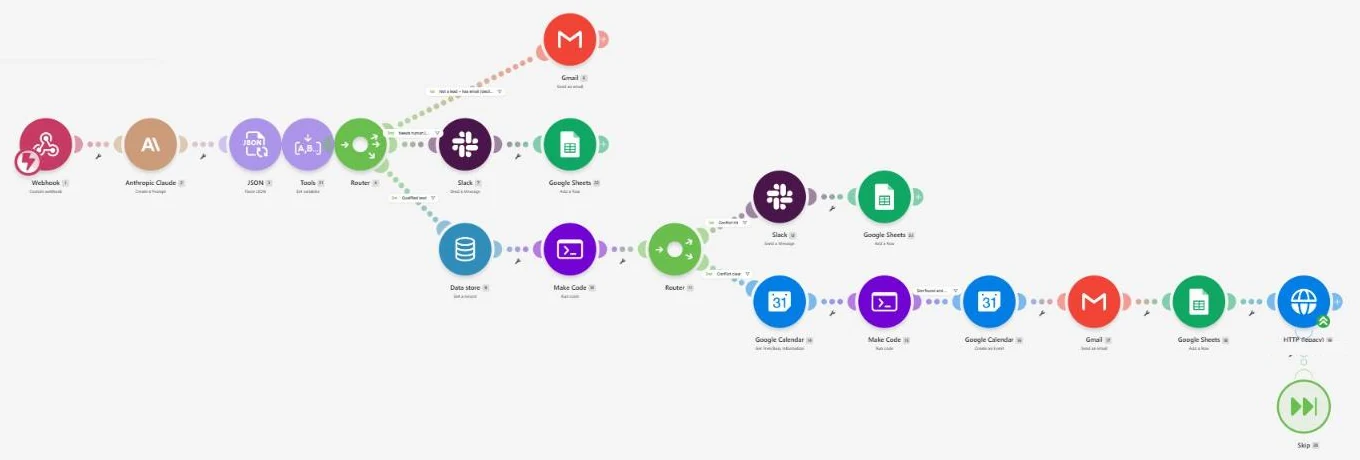
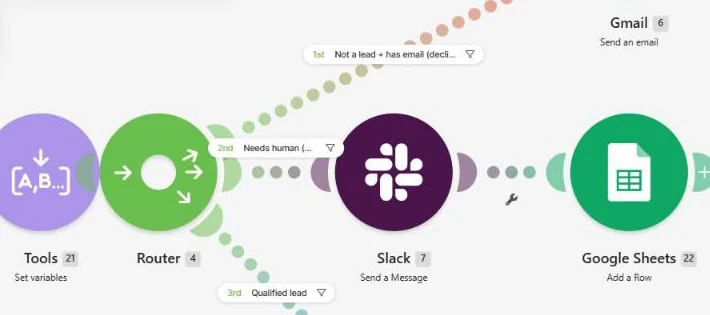
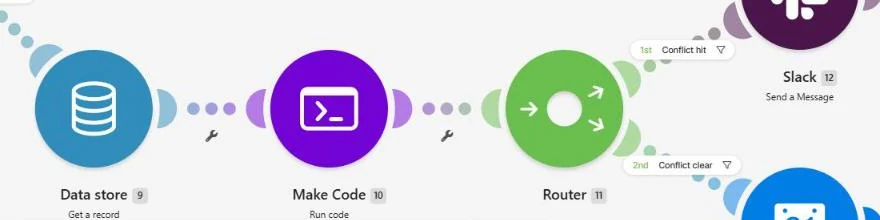

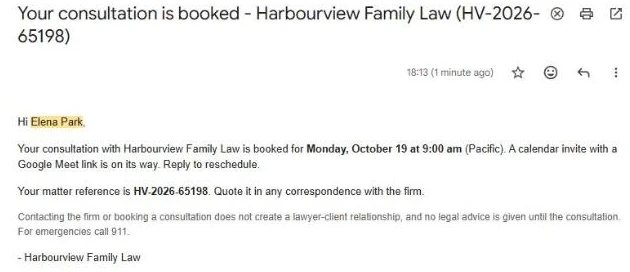
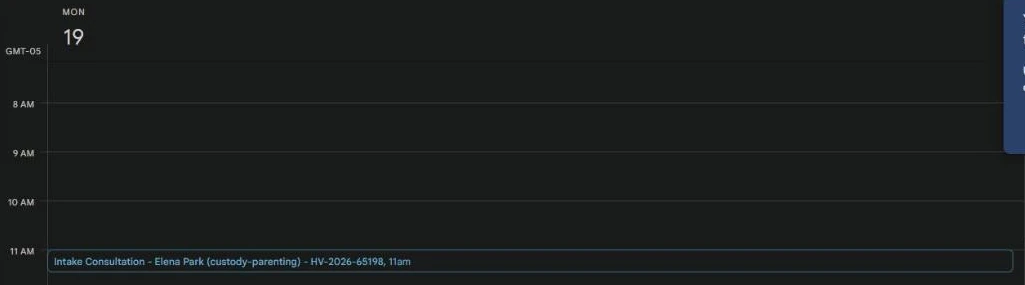
What lands, and where
What the test leads produced. The client gets a confirmation and an invite; staff get a ledger row and a Slack message with the reason.


The bug every run marked green
From the July build until August 8, the polite decline went to every lead with an email address, booked clients included. The dry runs missed it because nobody checked the inbox for extra mail, and Make showed every run as a success. The fix was one filter, is_lead must be false, and I confirmed it by op count: the booked path dropped from 12 operations to 11, the decline path stayed at 4. Now I check what a run did, not whether it errored. For a real firm the build would change in a few places. Their own Slack channel and domain, their actual conflict list, and a privacy review of what the parser is allowed to keep.
Under the hood
How it's built and how it was tested. Closed until you want it.
How it works
Inner Workings
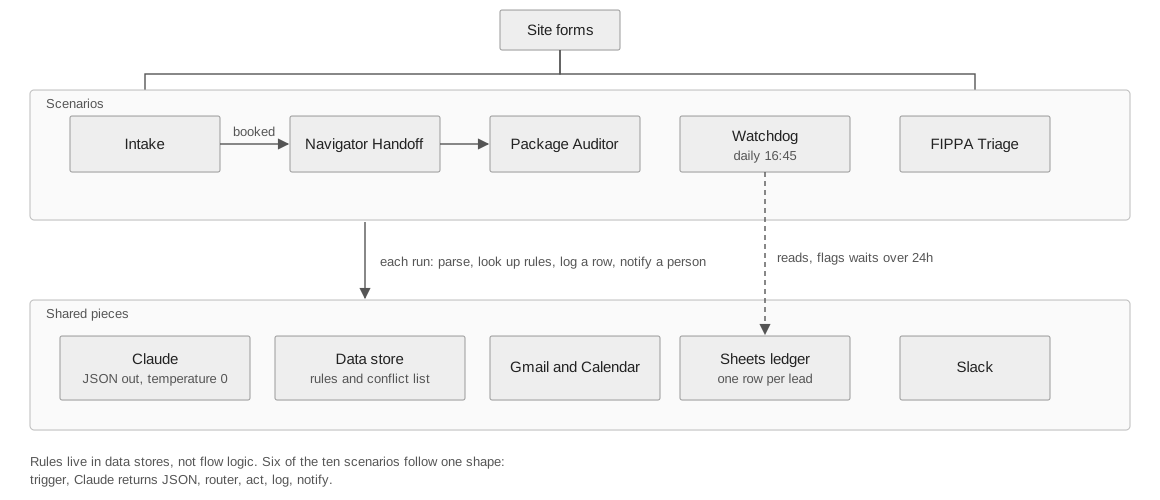
Intake is one of ten scenarios on the same Make account. Six of them share one pattern: a webhook or schedule in, Claude returning structured JSON, a router, then act, log to a ledger and tell a person. The rules sit in data stores, where the firm can change them without touching a flow.

Design process
Design Process
I wrote the runbook before the demo. Four test leads, each built to hit one branch, and every fix got written down next to the run that found it.
- ▸Mapped a small firm's manual intake, step by step
- ▸Named the one failure that matters: a missed conflict
- ▸Decided what the parser may and may not do
- ▸Intake JSON schema: contact, matter, urgency, conflict names, confidence
- ▸Four outcomes: booked, declined, needs human, conflict
- ▸Rules in a data store, not in flow logic
- ▸20-module intake scenario with a two-level router
- ▸Booking chain with an Ignore handler on the handoff
- ▸Navigator Handoff, Package Auditor, FIPPA Triage, Watchdog
- ▸Four runbook acts, one per branch, dry-run tested
- ▸Op counts checked per path, not just green runs
- ▸Daily watchdog: 30 runs, 0 errors
The numbers
The Impact
This is a demo, so the numbers are about whether the controls work, not about revenue. All of them come from the runbook dry runs and the live watchdog history.
Let's build something impactful.
I'm currently open to new opportunities in UX/UI Design, Product Design, and GovTech transformation roles.