PRIVACY IMPACT ASSESSMENT TOOL · FIPPA AND PHIA · BC and Manitoba · September 2026
Public bodies are adopting AI faster than they can assess it. Fipp walks the privacy assessment, stage by stage.
Two provincial Acts read at the source, 32 checks modelled with the provision named on each, and one widely cited section found repealed. Six stages in the order a coordinator thinks, a residency alert the moment data leaves Canada, and a sealed dossier at the end. Worked examples are fictional; the tool is research assistance, not legal advice.
Solo build. The statute model came first: the Acts, the regulations and the directions read at the primary source, each section checked for whether it is still in force, before any product code. Then the tool, a code review, a design audit, and a final pass where Fipp assessed its own AI feature. Built for the coordinator who has just been handed an AI tool and a blank template.
The Problem vs. The Solution
A public body adopting a tool that touches personal information owes a privacy impact assessment. The person assigned is rarely a lawyer, and AI tools ask questions the old template never did.
A blank template and a deadline
A walk instead of a form
The statute work came first
Before any product code, both Acts were read at the source and every check in the tool was traced to a provision that is in force. This is the part of the build a privacy office would examine, so it is the part shown first.
Sources, in the order they were read
Two calls a coordinator would recognise
Not covered, on purpose: access requests, the 30-day clock, extensions, fees, exceptions and Ombudsman complaints. Fipp is the privacy-protection side of the job only, and it is not legal advice.
The Impact
Fipp is a live demo, so the numbers are about legal credibility. In a compliance tool a wrong citation is the whole product failing.
Blank Template vs. Guided Walk
The old path loops: draft, submit, get it back, rework. Fipp’s path is a line, because the checking happens while you answer.
- 01Download the generic template
- 02Gather the Act, the regulations, the directions
- 03Work out which sections are still in force
- 04Draft every section by hand
- 05Send to the privacy office
- 06Wait for the comeback, rework, resubmit
- 01Describe the tool
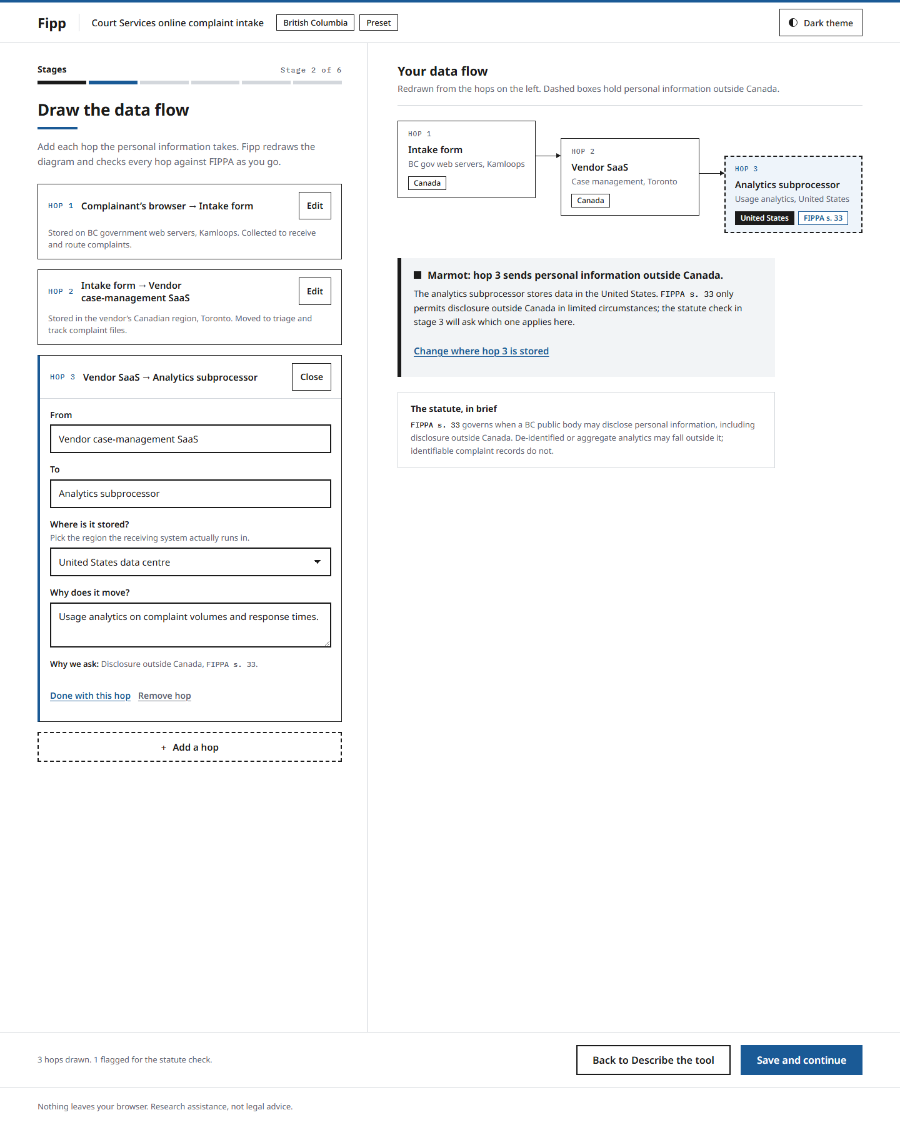
- 02Draw the data flow, hop by hop
- 03Check the statute, flags applied live
- 04Automated decisions and oversight
- 05Controls and mitigations, with owners
- 06The dossier, printed and sealed
Key Design Decisions
Three more calls shaped the product. The thread through all of them: in a tool about the law, honesty is the design system.
Not a smarter template. Six stages in the order a coordinator thinks, a spine that holds your place, four worked examples, and nothing leaving the browser.
A blank form transfers anxiety. A walk transfers process.
The dossier text is hashed, then the whole payload is hashed again with the time of the check. Same assessment, same engine, same dossier hash every time; the certificate hash moves with the timestamp, and the document says so. The instruction to re-run the check is printed on it.
A reviewer does not have to trust the tool. They can re-run it and watch the hash come back.
The second opinion never writes a citation. It picks ids from a pack the browser built, and an unknown id drops the whole finding.
Courts are fining lawyers for invented citations. The fix is an interface where inventing one is impossible.
An AI Lane That Can’t Invent Law
The engine flags what checkboxes can prove; a Make.com webhook carries the draft to Claude for judgment on the prose. The design problem was making a language model legally citable.
The pack is filtered by the same applicability rules as the on-screen checklist, so PHIA cannot be cited on an assessment with no health data.
The button breaks Fipp’s nothing-leaves-the-browser promise on purpose, so real drafts get a plain-words confirm first. Capped at forty reviews a day.
The lane failed its own assessment. Good.
Before shipping, the AI lane went through Fipp’s six stages as the tool under assessment.
Two alerts where data leaves Canada, six gaps, three with owners and dates. The sharpest: no agreement binds the vendors’ staff to the Act.
Inner Workings
Three views of the same machine: what is on the page, how one answer becomes a sealed dossier, and the states an assessment moves through.
Try it
The production build, embedded. Load a worked example, walk the stages, print the dossier. Nothing you type leaves your browser; it is not legal advice.
Inside the App
Real captures from the production build. Every image opens full size.
What shipped after the first cut
A review of the overnight prototype lane found the same four moves recurring: an exportable receipt, a rationale next to every override, plain language beside the citation, and the status logic made visible. Fipp had most of them. These four closed the gaps in a day, measured by the same tests.
Also shipped: a consent dialog on every AI review, including the worked examples; a Clear this assessment control on the dossier; a records stamp block on the printed page. 125 engine tests, the sealed hashes unchanged.
Design Process
Research first, because in this product the law is the material. Then three rounds of layout options, reviewed and cut between each. Then build, then verify.
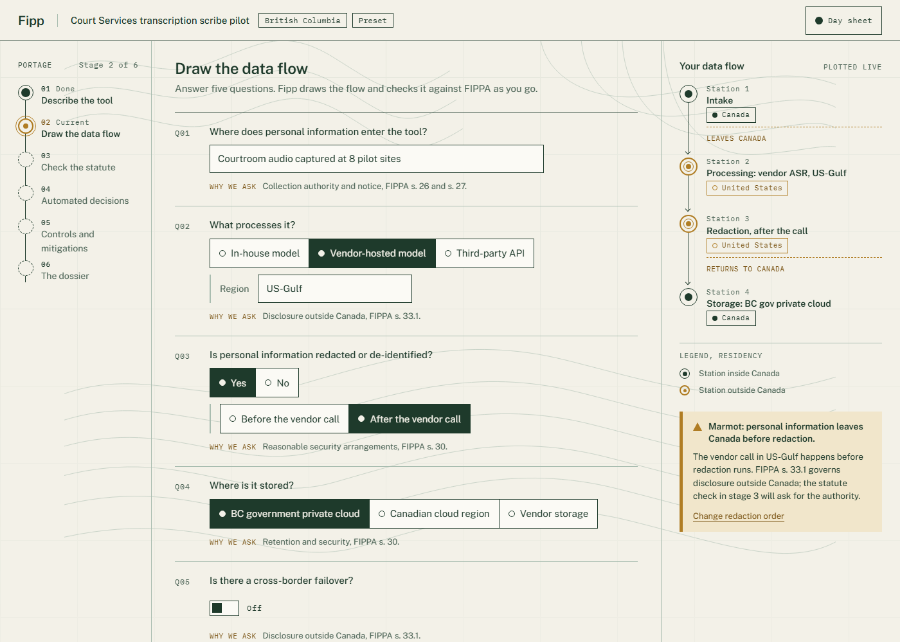
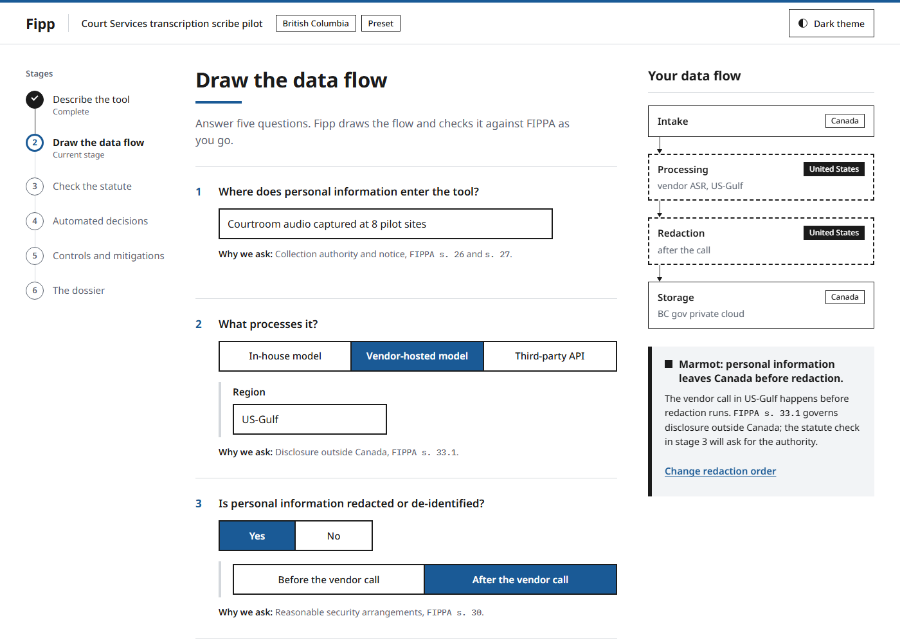
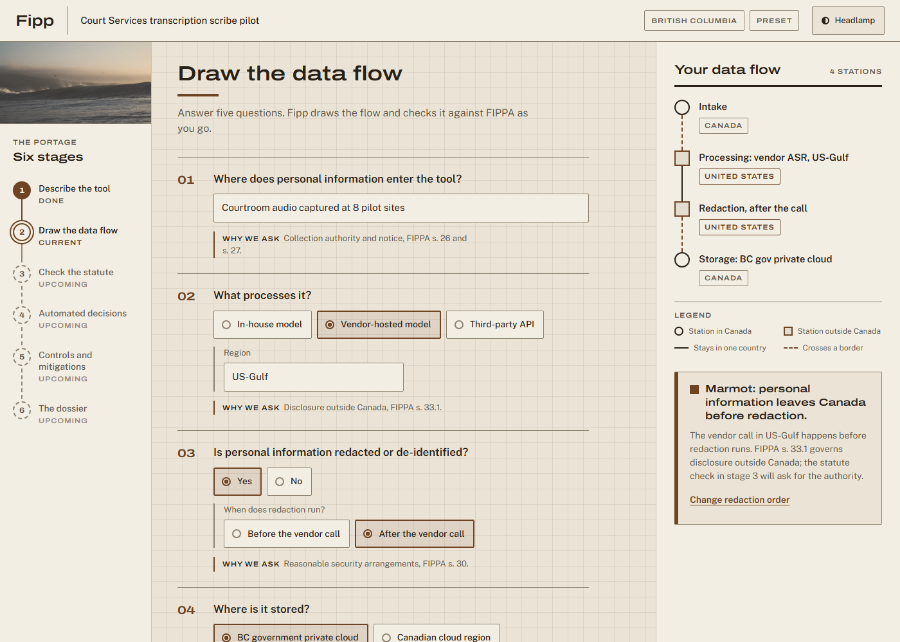
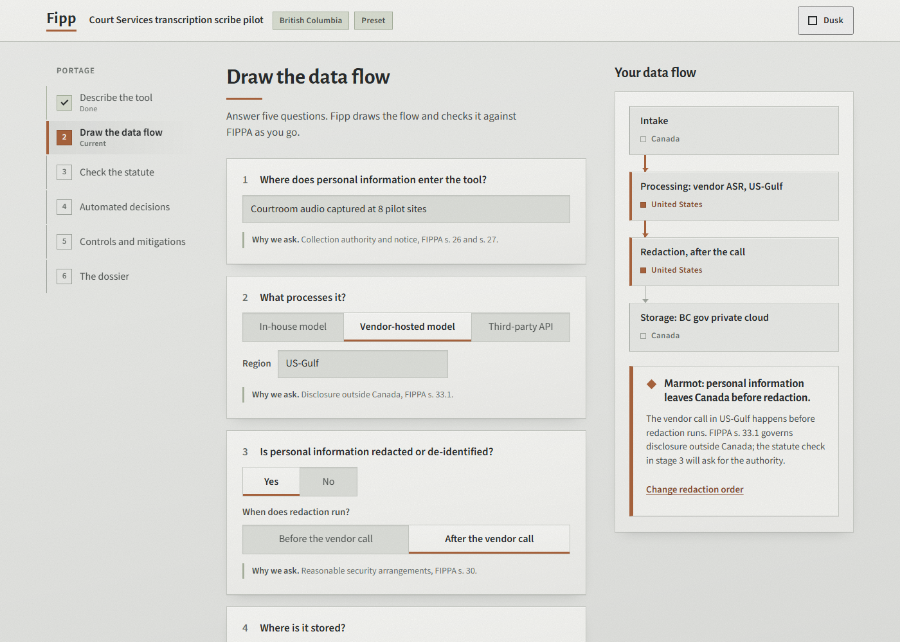
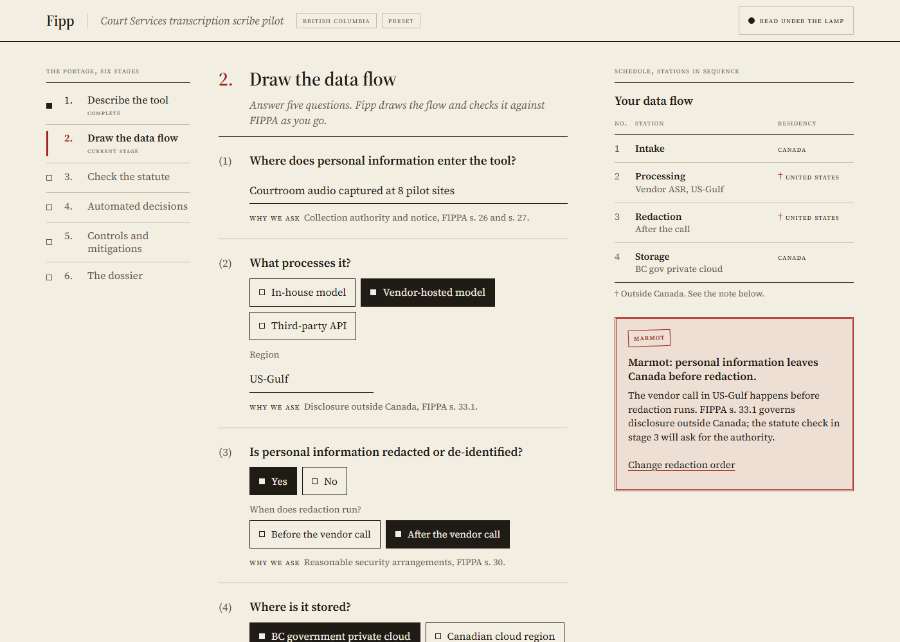
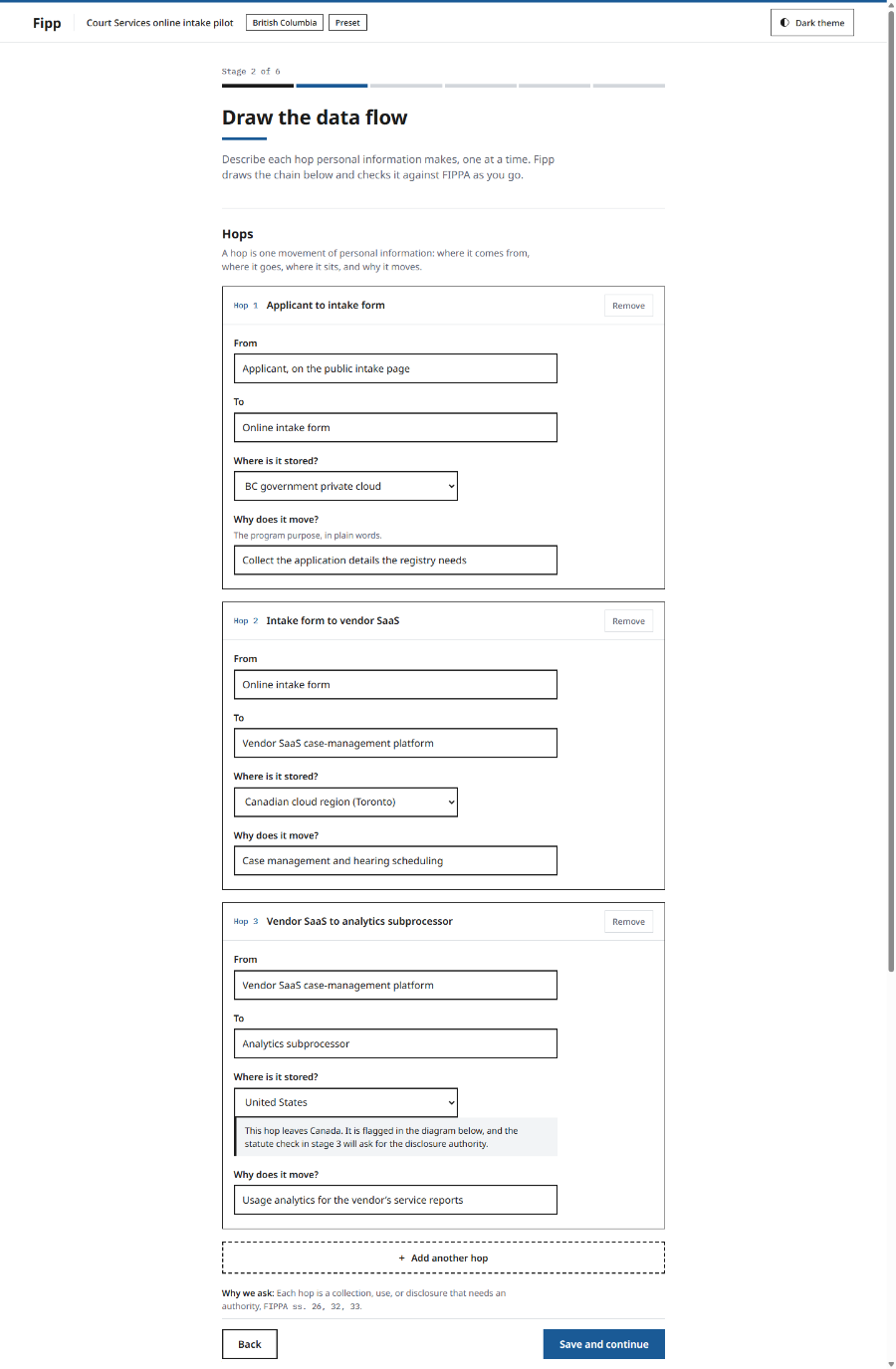
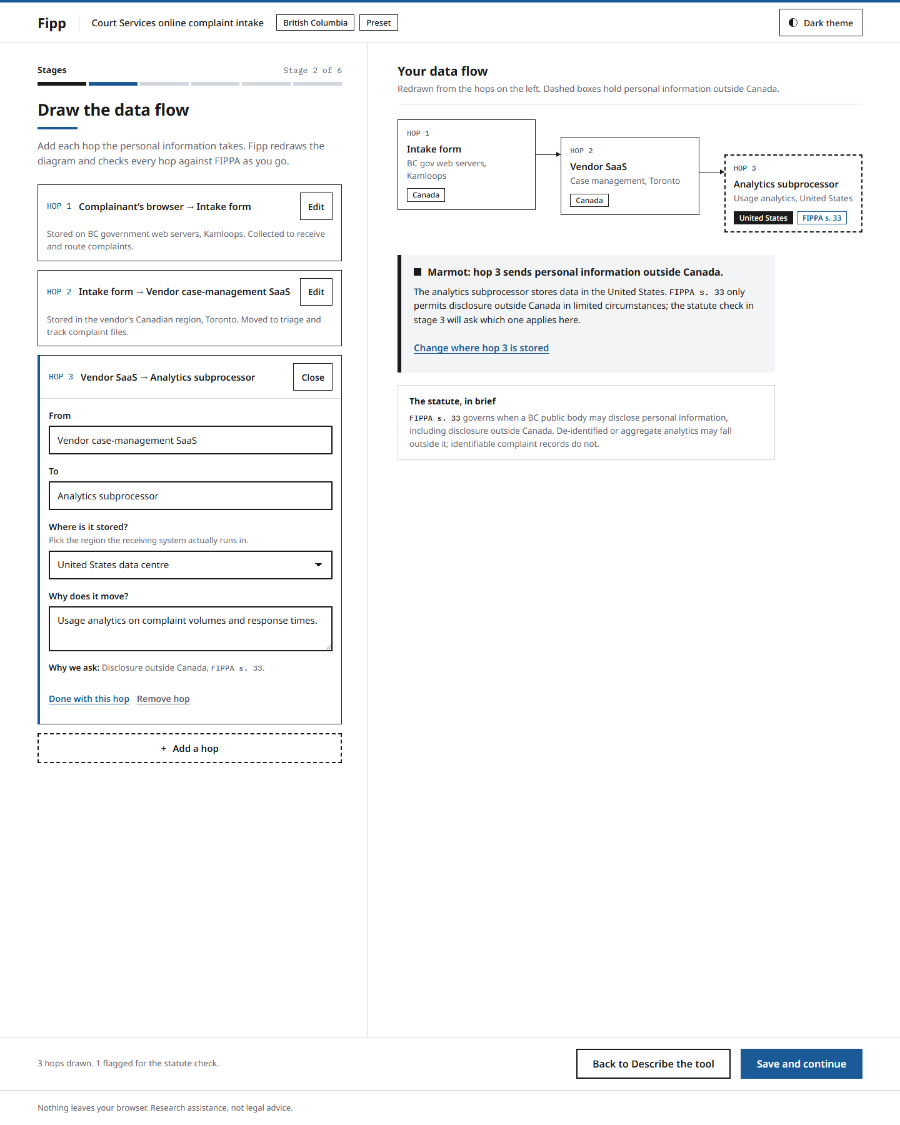
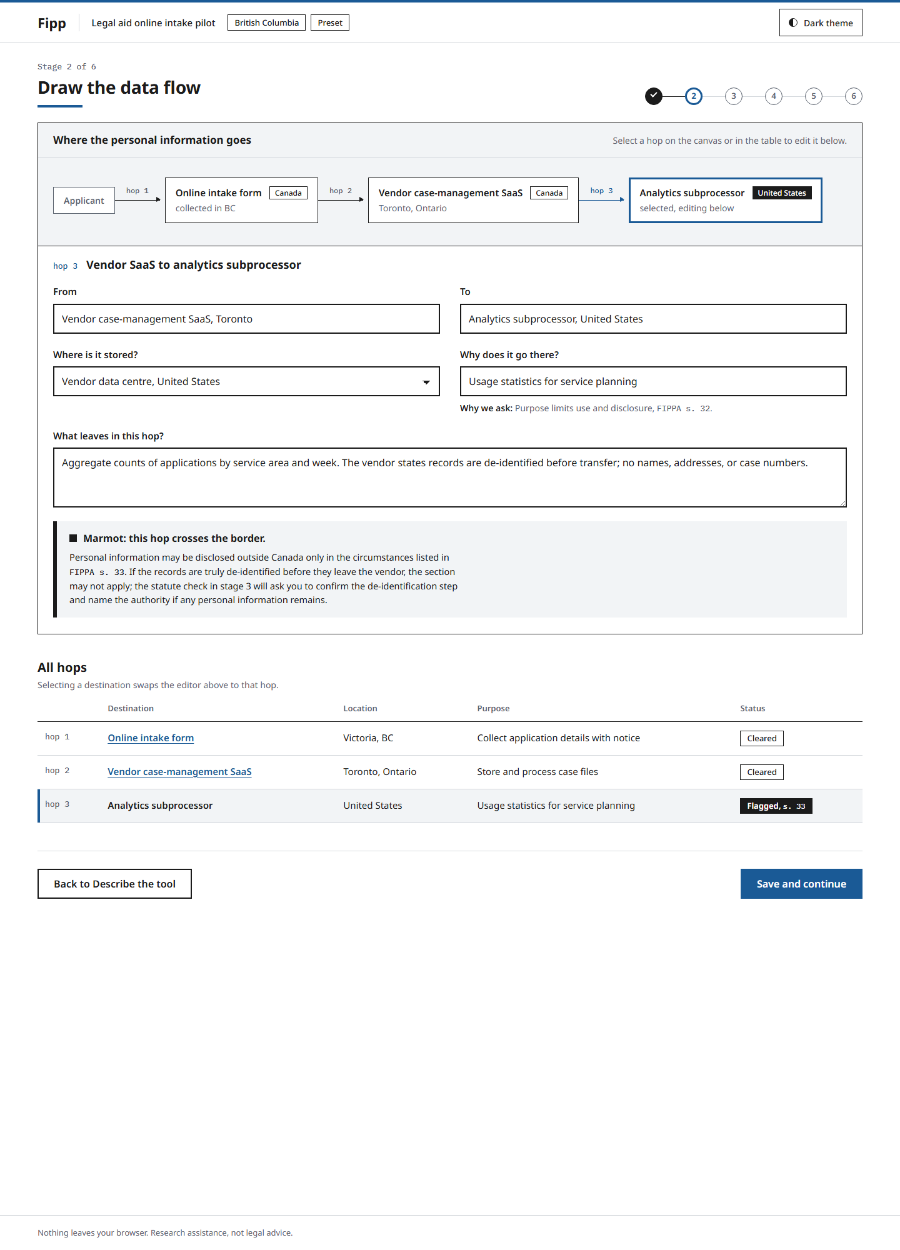
01 Research. Two earlier FIPPA builds folded into one brief; statute model verified at the source; s. 30.1 caught.
02 Layout rounds. Three rounds, each banked as one commit.
03 Build. Pure engine, profiles as data, six screens in parallel, static export.
04 Verify. Code review, design audit, then Fipp assessed itself.
We asked our privacy tool about its own AI feature. It said no.
The AI lane breaks Fipp’s core promise on purpose. The easy move was to bury that. Instead the lane went through Fipp’s own six stages, the engine returned Not ready, and the sealed dossier shipped with the product, gaps and owners included. A compliance tool earns trust the day you watch it refuse to flatter its maker.
Let's build something impactful.
I’m currently open to access and privacy, records and information, and GovTech roles, and to product design work in the public sector.